Colorbond vs Timber Fence on a Sloping Sydney Block: Which Suits Better?
Key takeaways
The manufacturer's installation guide recommends raking Colorbond panels (following the slope) rather than stepping them where possible. Beyond roughly a one-in-eight slope, a raked panel may need its infill sheets slit vertically, so it is worth having the slope measured before you choose a style.
Southside Fencing & Construction offers Colorbond fencing in the full Colorbond colour range at 1.5 m, 1.8 m and 2.1 m heights, with slat-top and lattice options and concrete-set posts. Colorbond steel fencing is low-maintenance, durable and termite-proof.
Choosing between Colorbond steel and timber for a boundary fence on a sloping Sydney block often comes down to how each material handles uneven ground, what your council allows, and what look you prefer. Both can work on a slope, but they behave differently when the land falls away or climbs steeply. Here is a practical comparison to help you decide which suits your site better.
How Colorbond Handles a Sloping Block Fence
The manufacturer’s installation guide recommends raking Colorbond panels (following the slope) rather than stepping them where possible. Beyond roughly a one-in-eight slope, a raked panel may need its infill sheets slit vertically, so it is worth having the slope measured before you choose a style.
Southside Fencing & Construction offers Colorbond fencing in the full Colorbond colour range at 1.5 m, 1.8 m and 2.1 m heights, with slat-top and lattice options and concrete-set posts. Colorbond steel fencing is low-maintenance, durable and termite-proof.
How Timber Handles a Sloping Block Fence
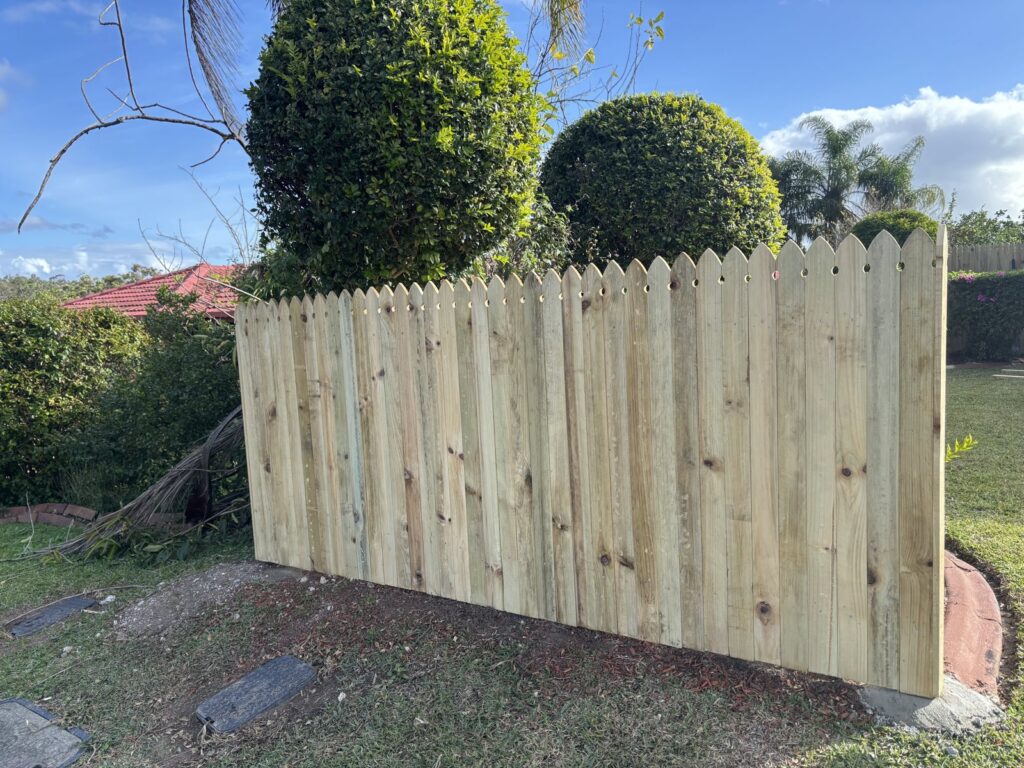
Timber palings can be raked so the rails and palings follow the ground contour, which avoids stepped gaps along the bottom of the fence.
Posts in ground contact should be H4 treated pine, while H3 treated pine is sufficient for rails and palings. Southside builds timber fencing in treated pine paling, lapped and capped premium finishes and hardwood feature panels, using galvanised fixings and properly set posts.
Raked or Stepped Fence: What Works for Your Slope?
A raked fence follows the fall of the land, so the rails and panels tilt with the slope. A stepped fence is built in level sections that drop in height as the ground falls.
For Colorbond, the manufacturer’s guidance favours raking where possible. For timber, raked palings follow the ground contour and avoid stepped gaps. If your slope is steep or uneven, the best style depends on the angle, access and ground, and it is easiest to confirm on site.
The choice also depends on your neighbour if you are sharing a dividing fence, and on what your local council permits.
Bushfire-Prone Land Fence Rules in Sydney
Some parts of Sydney may be mapped as bushfire-prone land, so check your block with your council.
In NSW, fences built as exempt development in residential zones R1, R2, R3, R4 and RU5 must have side and rear boundary fences no higher than 1.8 metres. On bushfire-prone land, exempt fences must be constructed of non-combustible materials or hardwood.
That rule names the materials, so ask your council or certifier whether the fence you have in mind is allowed on your block before you order. Heights also matter: we offer Colorbond fencing in 2.1 m panel heights, which is above the 1.8 m limit for exempt side and rear fences in those zones, so check with your council or certifier before choosing a fence taller than 1.8 m.
Source: NSW Planning Portal, Fences (exempt development).
Neighbour Contributions and Sufficient Dividing Fences
In New South Wales, the law does not say what type of fence neighbours must build. Neighbours generally contribute equally to a sufficient dividing fence. What counts as sufficient depends on the existing fence, how the land is used, privacy needs, fences common in the area, and council requirements such as bushfire restrictions.
If your block slopes and your neighbour’s does not, or if one side is bushfire-prone and the other is not, these factors can affect the discussion about materials and cost sharing. It is worth talking to your neighbour early and checking council rules together before choosing a material or style.
Source: NCAT, Dividing fences.
Other Practical Differences Between Colorbond and Timber on Slopes
Colorbond is a low-maintenance, durable and termite-proof option that comes in the full Colorbond colour range. Timber gives a warmer, traditional look, with treated pine palings, lapped and capped finishes and hardwood feature panels available, and galvanised fixings throughout.
Cost depends on length, height, access, ground conditions, materials and removal of any old fence, so the most reliable way to compare is to request a quote for each material on your actual slope.
Choosing the Right Fence for Your Sloping Block
There is no single right answer for every sloping block in Sydney. Colorbond suits owners who want low maintenance and a clean, modern finish. Timber suits those who prefer a natural look, with raked palings that follow the ground.
Consider your slope, whether your land is bushfire-prone, what your neighbour is likely to support, and what your council allows. If you are unsure which material will work best on your site, a site inspection can clarify what is practical.
Southside Fencing & Construction has a Sydney base in the Austral and Leppington area (NSW 2179). Contact us to confirm availability for your suburb. To discuss your sloping block, request a free quote through our contact page or email info@southsidefencing.com.au. Helpful details include your suburb, the work needed, approximate lengths, preferred material or finish, and a few photos of the slope.
FAQ
Can you rake a Colorbond fence on a slope?
Yes. The manufacturer’s installation guide recommends raking panels rather than stepping them where possible. Beyond roughly a one-in-eight slope, the infill sheets may need to be slit vertically.
Is timber easier to fit on a sloping block than Colorbond?
Timber palings can be raked so the rails and palings follow the ground contour, avoiding stepped gaps. Either material can suit a slope, and the best choice depends on the angle and your site.
What are the fence material rules on bushfire-prone land in NSW?
Exempt fences on bushfire-prone land must be constructed of non-combustible materials or hardwood. Check with your local council whether your land is mapped as bushfire-prone and what is allowed on your block.
Who decides the fence type when I share a fence with a neighbour?
The law in NSW does not say what type of fence you must build. Neighbours generally contribute equally to a sufficient dividing fence, which depends on the existing fence, land use, privacy, fences common in the area and council requirements. If you cannot agree, the Local Court or NCAT can decide.
Does a taller fence need approval?
In the NSW residential zones R1, R2, R3, R4 and RU5, side and rear fences up to 1.8 metres can be exempt development. Taller fences may need approval, so check with your council first.